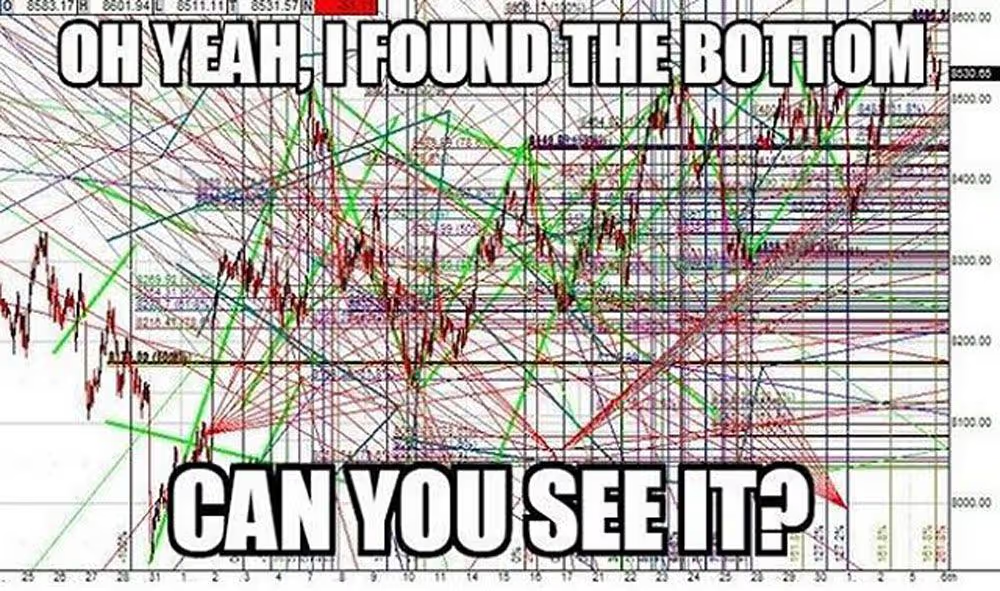
Famous Bitcoin price prediction models generally fall into two categories: fundamental, scarcity-based models (long-term view) and traditional technical models (short-term view).
Fundamental & Scarcity-Based Models
- Stock-to-Flow (S2F) Model: Popularised by PlanB, this model treats Bitcoin as a scarce commodity similar to gold. It calculates price based on the ratio between existing supply ("stock") and new annual production ("flow"). It argues that as the supply inflow decreases (specifically during halving events), the price should rise.
- Bitcoin Power Law: This model suggests that Bitcoin’s price growth follows a predictable, long-term power law function relative to time, rather than just supply. It argues that cycles of boom and bust are part of a stable, long-term exponential growth trend.
- Bitcoin Rainbow Chart: A logarithmic growth curve model that visualizes the price over time, using bands of color to indicate whether the asset is overbought ("bubble") or oversold ("fire sale").
Technical Analysis (TA)
- Moving Averages (MA & EMA): Used to identify trend direction and potential reversals.
- Relative Strength Index (RSI): Measures velocity and magnitude of price movements to identify overbought or oversold conditions.
- Moving Average Convergence Divergence (MACD): Tracks momentum by comparing short-term and long-term exponential moving averages.
- Bollinger Bands: Measures market volatility.
- Volume Indicators (e.g., OBV, VWAP): Confirms price movement strength based on trading volume.
- Fibonacci Retracement: Used to identify potential support and resistance levels.
Macro Correlations & Institutional Drivers
- M2 Money Supply - Prior to 2025 there was a strong narrative that Bitcoin acts as a classic inflation-hedge and would therefore strongly correlates with the M2 Money Supply (with a 70 day lag... for some reason). Lyn Alden's research suggested a very strong correlation (94%) with global M2 liquidity from 2013–2024, because as a borderless, fixed-supply asset, it acts like a pure barometer for worldwide money expansion - rising when liquidity floods in and drawing demand as fiat debasement accelerates. The narrative might still be true in the long-term, but has gone relatively quite since the decoupling that began in mid-2025.
Bitcoin has completely decoupled from Global M2. What do you think happens next? pic.twitter.com/uJPNqfO5Wb
— The ₿itcoin Therapist (@TheBTCTherapist) November 10, 2025
- Tech/Software ETFs - Bitcoin and the technology sector have also tracked each other with remarkably close correlation - trading like the iShares Expanded Tech-Software ETF (IGV) since 2021/22. During the Feb 2026 sell-off the 30-day rolling correlation reached 73% - stronger than Bitcoin’s correlation with the Nasdaq‑100 (Source). Bitcoin is software at its core: open-source code running on a decentralised global network. Yet the correlation suggests that the market is currently pricing it as “just another software play” - lumping it into the same high-beta tech bucket as traditional Software as a Service (SaaS). The Oct 2025 - Feb 2026 drawdown seems to expose the downside of that generic categorisation - while software stocks were being hammered by legitimate AI disruption fears eroding SaaS valuations (e.g. Anthropic’s Claude Cowork/Code and open-source frameworks like OpenClaw automating workflows) - Bitcoin was likely caught in the same correlated downdraft, even though it does not face the same existential threat → See Quantum FUD 🐇.
This is unbelievable.
— Simply Bitcoin (@SimplyBitcoin) February 11, 2026
Bitcoin has been mimicking the Software ETF for over five years. pic.twitter.com/DkpVD4HSXn
BITCOIN vs. iShares Tech-Software Sector ETF pic.twitter.com/9okCUmEEsg
— sunnydecree (@sunnydecree) February 22, 2026
For both correlations it's worth remembering that even the strongest statistical relationships can be entirely spurious - as Tyler Vigen famously illustrated on his website Spurious Correlations, where random public datasets produce hilariously high but meaningless correlations (for example: pirate attacks globally having a 97.4% correlation with Google searches for 'download firefox')... reminding us that correlation does not prove causation.

And anyways, a single event could simply wipe out all the current models/narratives... as Michael Saylor put it:
What happens to all these wonderful models if 10 billionaires decide to buy $1 billion of Bitcoin each and announce we bought it? We're not ashamed of it. We're going to buy more. All your models are destroyed, completely devastated. Bitcoin goes to the moon.
Michael Saylor asking what would happen if 10 billionaires bought $1 billion of #Bitcoin each 🤯
— Documenting Saylor (@saylordocs) March 16, 2025
ALL YOUR MODELS ARE DESTROYED. pic.twitter.com/AqOWBdHQdE
